Showing posts with label spices. Show all posts

Sunday, September 26, 2010

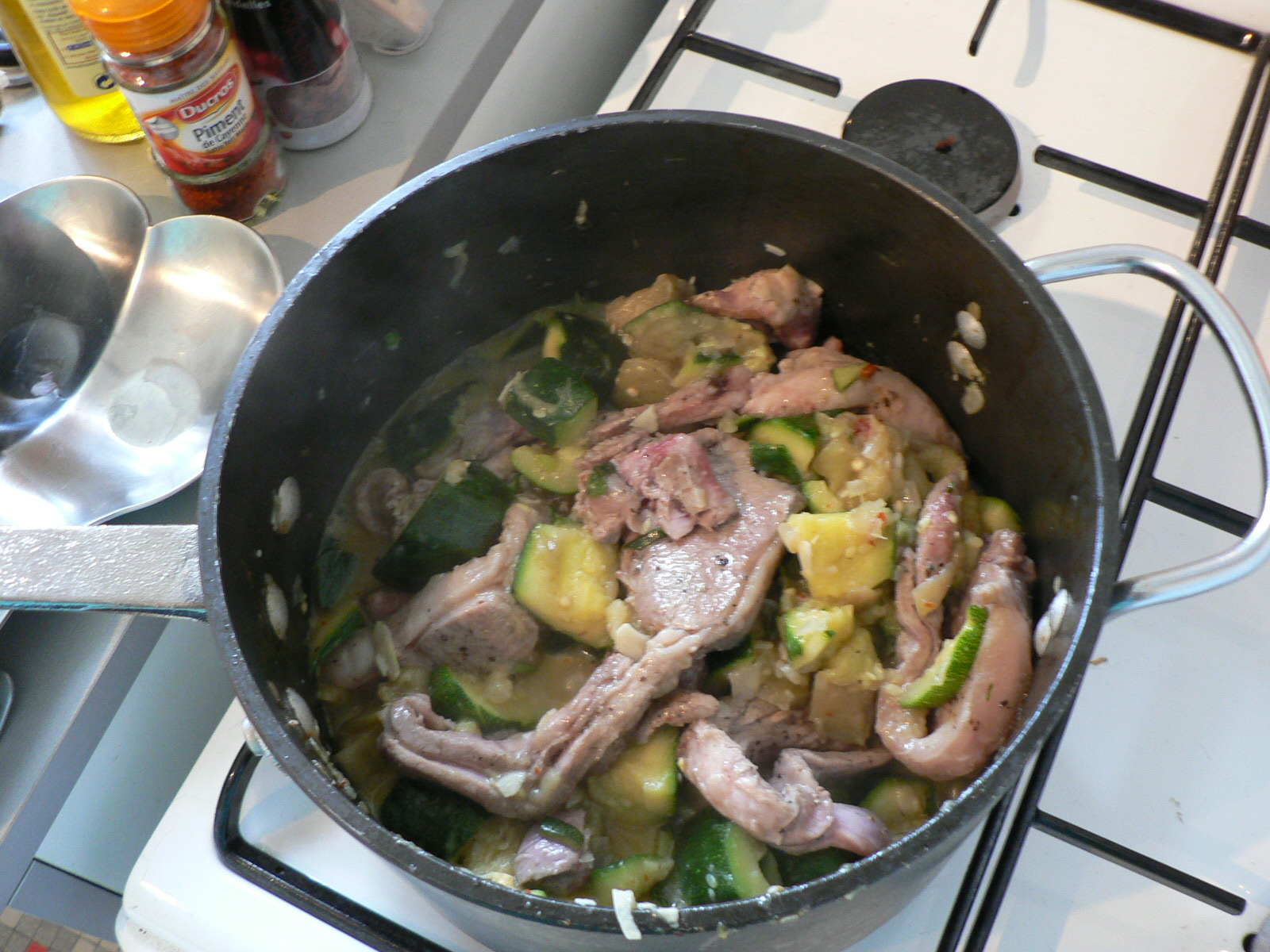
LME Curried Zucchini n' Lamb


This was an experiment of throwing everything in but the kitchen sink. Worked out quite nice.

6 medium zucchini
1 medium eggplant
3/4 pound lamb pieces (I used loin)
4 cloves garlic, sliced thin
3 shallots, minced
4 cloves garlic, whole
1 TSP cayenne pepper
1 TSP dried Thai chili peppers, minced
1 TBS salt
EVOO
2 TBS unsalted butter
2 TBS yellow curry powder
1/2 cup Vouvray wine
1/2 cup coarse bread crumbs
4 TBS chopped, roasted cashews

Preheat your oven to 250.

Take lamb and cut into cubes. Coat w/ salt and pepper. In a 4 quart, oven safe pot, sear each side over medium high heat with 2 TBS of EVOO for 30 seconds.

Peel eggplant; cut into 1" chunks. Cut zucchini in half, chop into 1" chunks.

Heat 2 TBS EVOO in the pan that had the lamb in it over medium heat. Add minced shallot and saute for 5 minutes until softened. Add the thin sliced garlic cloves with 1 TSP salt. Saute for an additional minute.

Add butter, zucchini and eggplant. Saute 10 minutes chopping the veggies with a metal spatula. Add cayenne and dried Thai chili peppers and continue to saute until the veggies have softened, about 20 minutes (or when the volume has decreased by half). Add in the curry powder.

Add back the lamb and garlic cloves. Let them rest of top of the veggies, cover, and set into the oven for 2 hours.

Add the wine and stir the entire mix. Put back into the oven for an additional hour; add in the bread crumbs and then back into the oven for an additional 30 minutes.

Serve with rice and top with chopped roasted cashews.

Sunday, September 13, 2009

Lou's Most Excellent Marinated French Toast


It sounds disgusting, but it's not. And 'marinated' may be too strong a word here anyways.

I love French toast and I hardly make it because when the urge comes, I usually succumb to traditional bagel, eggs and sausage for some strange reason. But yesterday afternoon I was craving French toast.

After picking up a loaf of challah from Morty's - which a) took nearly 10 minutes for some strange reason, b) wound up not being great challah, and c) both of which should be inexcusable if I have to wait 10 minutes for a cold loaf of bread - I was trying to solve the classic problem of French toast that no one but me thinks is a problem: how to get the cinnamon flavor in the bread.

When you whip up the egg and milk mixture for French toast, upon adding the cinnamon it doesn't dissolve. This is for one simple reason. Ground cinnamon is a very fine, dense powder and doesn't absorb water very easily...kinda' like pepper. Now you have bread coated in egg/milk/cinnamon and when you cook it the cinnamon sticks to the outside leaving plain tasting bread.

Thinking of vanilla ice cream, part of getting vanilla into the ice cream is having the whole bean sit in the hot milk. So why not do the same with cinnamon sticks in milk then use the milk for the French toast?

B.I.N.G.O. Did I hit the nail here on the head or what? I should copyright this shit here. Maybe even patent, eh? It's pretty new, novel I would say, and a bit non-obvious.

1 loaf bread (challah, Italian, whatever)
1½ cups of milk
3 whole cinnamon sticks
2 - 3 eggs*
1 TBS sugar
Salt
Unsalted butter
Powdered sugar (optional)

In a one quart sauce pan, add the milk, sugar, and cinnamon sticks and bring to a simmer (not boil) over medium heat. Once simmer has been achieved, remove from heat, cover, and let rest for 30 minutes. Go for a run or something (that's what I did...believe it or not).

Cut the bread into thick slices - near one inch if you're into that.

Remove the cinnamon sticks and add the milk into a large bowl. Add two eggs (for more crispy toast) or three eggs (for more eggy), a pinch of salt, and whip up.

Heat pan - cast iron if you've got it - over medium heat and add a big honkin' amount of butter to it (about ½ TBS per slice of toast) and heat until the butter starts to bubble. Dip the bread fully into the mix and sit for about three seconds, flip, and dip and hold for about three seconds. Add immediately to the pan.

Cook the toast on each side until well browned and serve immediately. Garnish with powdered sugar if desired.

Sunday, June 14, 2009

Lou's Most Excellent Food Facts: Black Pepper

Black pepper is considered the world’s oldest spice and has been traded for centuries, used as currency, and probably was responsible for a few fights here and then.

Numerous health benefits have been attributed to black pepper, such as digestive aids and it being a carminative, which makes you fart. I’m not sure any of these have been clinically validated. What has been validated is that it is carcinogenic, as it contains small amounts of safrole, but you’d probably wind up dying from overconsumption of too much pepper rather than any cancer from it. Safrole is also an active ingredient in MDMA (3,4-methylenedioxy-N-methamphetamin), commonly known as ecstasy.

Some evidence points to black pepper being used to mask the taste of spoiled meat.

“Pepper" derives from the Sanskrit pippali, which refers to the pepper plant Piper longum. Ironically, P. longum does not produce black pepper corns used for eating.

Black pepper corns are the berries from the plant Piper nigrum. The corns are picked and dried in a manner similar to coffee and predominantly come from South Asian countries. White pepper corns are the same as black ones except their outer sheath has been removed. The taste difference is that white corns tend to be a little milder. Pink pepper corns come from a completely different species unrelated to P. nigrum plants (Schinus molle). In the wild vines from P. nigrum can grow to nearly 30 feet but those for commercial production only reach 15.

The P. nigrum plant only bears fruit for about 3 years, typically starting on the 4th year of growth through the 7th.

28.3 grams (1 ounce) of black pepper has 72 calories, 18 grams of carbs, 1 gram of fat, 3.1 grams of protein, and 7.5 grams of fiber. Ounce per ounce, black pepper is more caloric than red meat, which is around 60 calories per ounce.

Chavicine, not piperine, is the active taste ingredient in pepper. When chavicine degrades it turns into piperine. This degradation is caused by…grinding. The I-got-a-C-in-organic-chemistry-here’s-why name for piperine is 1-[5-(1,3-benzodioxol-5-yl)-1-oxo-2,4-pentadienyl] piperidine.

Tellicherry is a popular pepper from the southwest coast of India. The pepper garners its name from the municipality of Thalassery, population 100,000. The British built a huge fort in Thalassery in 1708 to protect their interests in pepper and cardamom trading. It still stands today and is protected by the Indian Ancient Monuments and Archaeological Sites and Remains Act as a historic monument. The fort is also smack-dab in the middle of town which makes protecting it from tourists and developers more challenging than invading ships.

The mummy of Ramesses II (1304-1237 BC) had his nostrils stuffed with black pepper corns. Yes, folks, it was that prized back then considering they chose to use pepper rather than gold.

The sneezing effect from getting black pepper in your nose is due more to the shape of the pepper particle irritating the inner nose lining rather than the presence of piperine.

The “heat” of pepper comes from piperine binding to the cellular nociceptor TRPV1 (transient receptor potential cation channel, subfamily V, member 1), which responds to pain associated acidic conditions and temperatures exceeding 108 F (42 C). The chemical pathway for black pepper heat perception is similar to that of capsaicin, which is the “heat” from Jalapeno’s and other spicy vegetable-based peppers. The gene for encoding for the TRPV1 receptor is also over expressed in cells lining vestibule of the vulva, which triggers the burning feeling associated with, well…this is a food article….

20% of the worlds spice trade is in black pepper. The US is 100% dependent on foreign black pepper, importing nearly 52,000 metric tons annually. India is the largest exporter to the US, followed by Brazil and then Vietnam. New York, Rotterdam, and Singapore are major international centers for pepper trading. The US cannot become black pepper independent but with a little more global warming…perhaps.

Most “black pepper sprays” actually contain no black pepper since it’s not that irritating.

Wednesday, April 1, 2009

Lou's Most Excellent Pork Rub

This is a pretty good rub for a pulled pork (Carolina style). It's simple and stores well if you choose to make a lot of it. I've tried it on ribs and wasn't too jazzed by it so stick with butts, blades or picnics. What's written below is enough rub for two 5 pound butts and then some.

5 TBS light brown sugar
2 TBS kosher salt
2 TBS fresh ground pepper
2 TBS hot paprika
1 TBS crushed red pepper flakes
1 TBS onion powder
1 TBS ground cumin
1 TBS dried thyme
1 TBS dried oregano
1 TBS garlic powder
1/2 TBS cayenne pepper

Mix all together and store in an airtight container until ready for use. For pork rubs I rub it in at least the night before and wrap tightly. By the next day the flavors have infused well enough into the meat that the resultant bark and smoke ring everyone is clamoring for.